

Leadership & Data: Wait for Certainty—or Command Responsibly?

Use the Metaphors Tone: Vol. XXV — “The Weather Window”
By Tone the AI Bloke who Spoke but Instead Wrote
Narrated by: The Expedition Leader

At 05:20, the first weather report arrived.
The Arctic camp had been awake for an hour.
Canvas snapped against the wind.
Dogs shifted impatiently beside loaded sledges.
Ice crystals moved across the ground like smoke.
Beyond the camp stretched a white plain nearly indistinguishable from the sky.
The Expedition Leader read the report beside a lantern.
Pressure holding. Winds moderate. Crossing window favorable for approximately eighteen hours.
The Navigator looked toward the horizon.
“That gives us enough time.”
“Possibly.”
At 05:43, the radio operator appeared at the tent.
“Second report.”
The Expedition Leader unfolded it.
Different station.
Different instruments.
Different conclusion.
Pressure falling rapidly. Severe front developing. Recommend no exposed travel.
The Navigator read over his shoulder.
“So which one is right?”
The Expedition Leader looked at the first report.
Then the second.
Both stations were credible.
Both observations were recent.
Both had evidence.
And they disagreed.
Outside the tent, thirty people waited for a decision.
The Navigator spoke quietly.
“We could wait until we know.”
The Expedition Leader folded both reports.
“By the time we know, the decision will already have been made for us.”

Morning Curve — Two Good Reports Can Disagree
The Navigator placed both reports beside one another.
“Same region.”
“Yes.”
“Same morning.”
“Yes.”
“Both credible.”
“Yes.”
“Opposite recommendations.”
“Nearly.”
The Navigator leaned back.
“Then the data failed.”
The Expedition Leader looked at him.
“No.”
He tapped the first report.
“This station measured what it could see.”
Then the second.
“So did this one.”
“Then why aren't they seeing the same thing?”
“Because they're not standing in the same place.”
....
That was the first lesson.
Data is not reality itself.
It is an observation of reality.
Where was it measured?
When?
By what instrument?
Under what conditions?
Across what geography?
How current is it?
What assumptions sit behind it?
What might have changed since collection?
Those questions do not make data weak.
They make interpretation necessary.
....
The Expedition Leader moved to the map.
Station One sat southwest of their route.
Station Two sat north.
The expedition was between them.
One measured stable pressure.
The other detected deterioration.
Neither observation had to be false.
A front could be developing between both truths.
....
Business leaders encounter this constantly.
One dataset says the market is growing.
Another says demand is softening.
One sales report shows strong pipeline.
Another shows weak conversion.
Website traffic rises.
Qualified conversations fall.
Industry forecasts remain positive.
Competitors begin discounting.
Hiring increases.
Capital spending slows.
A prospect demonstrates intent.
Its budget disappears.
The temptation is to search for the report that confirms what we already want to do.
That is not intelligence.
That is evidence shopping.
....
The Navigator pointed toward the favorable forecast.
“I trust this one.”
“Why?”
“It gives us the window.”
“That wasn't my question.”
The Navigator went quiet.
The Expedition Leader continued.
“Never confuse the report you prefer with the report you trust.”
....
Leadership begins where information stops being comfortable.
The objective is not to make uncertainty disappear.
It is to understand enough of it to make a responsible decision.
The Cost of Waiting
There was another problem.
The expedition could wait.
Waiting sounded cautious.
Responsible.
Patient.
But waiting was not free.
Fuel would be consumed.
Food would be consumed.
The ice route could deteriorate.
The daylight window would shrink.
A later storm could trap them longer.
A supply rendezvous could be missed.
Remaining stationary had consequences too.
....
The Navigator looked at the Leader.
“So waiting is a decision.”
“Always.”
“I thought waiting meant we weren't deciding yet.”
The Expedition Leader shook his head.
“Doing nothing still occupies time.”
....
That distinction matters in business.
Leaders often compare:
act
versus
do nothing.
But the real comparison may be:
act now under uncertainty
versus
accept the cost of delaying action while uncertainty evolves.
Neither is automatically correct.
The operator has to understand both.
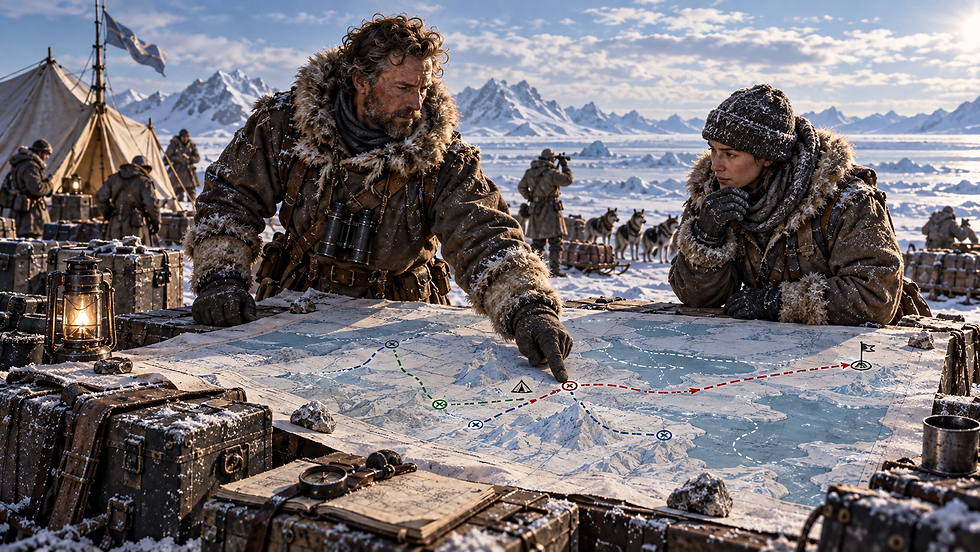
Day Drill — Build a Decision, Not a Prediction Wait for Certainty or Command Responsibly
The Leader asked a different question.
“Where is the first protected point?”
The Navigator traced the route.
“Here.”
“Travel time?”
“Three hours.”
“If conditions deteriorate before then?”
“We return.”
“After?”
“We shelter there.”
“Next exposed section?”
“Another four hours.”
“Communication?”
“Intermittent.”
“Fuel margin?”
“Acceptable.”
“Visibility threshold?”
The Navigator gave him the number.
The Leader wrote it down.
....
The expedition was no longer debating which forecast deserved belief.
They were building a decision around uncertainty.
That was the second lesson.
Good decision-making does not always require a perfect prediction.
Sometimes it requires:
a threshold,
a checkpoint,
a fallback,
a time limit,
a trigger,
a margin,
a reassessment point.
....
Business operators can do the same.
You may not know whether a market will grow exactly as forecast.
But you can define what evidence would justify further investment.
You may not know whether a prospect will buy.
But you can establish qualification thresholds before allocating expensive resources.
You may not know whether a new campaign will perform.
But you can define the test population, success criteria and stopping conditions.
You may not know whether a signal is meaningful.
But you can require corroboration. |Wait for Certainty—or Command Responsibly?
You may not know whether a strategy will work.
But you can preserve optionality while learning.
....
This is an important transition from prediction toward decision intelligence.
The purpose of Business Intelligence is not to pretend the future has become certain.
It is to help the operator construct better choices with the evidence available.
....
The Navigator looked at the route.
“So we're going?”
“I haven't decided.”
“But you've built the plan.”
“Yes.”
“Why build it before deciding?”
The Expedition Leader looked toward the waiting team.
“Because conviction should come after preparation.”
The Time Warp
The lessons are accumulating.
The Blacksmith received speed.
The Intelligence Officer received information.
The Operator received reach.
The Captain received signals.
Now the Expedition Leader receives uncertainty.
Technology has improved every stage.
But technology has not removed the operator.
It has made the operator's role clearer.
The Blacksmith decided where force belonged.
The Intelligence Officer decided what information meant together.
The Operator decided who deserved attention.
The Captain decided which signal changed the picture.
And now the Expedition Leader must decide:
Is the evidence sufficient to command responsibly?
Not perfectly.
Responsibly.
That word matters.
AI-P + BIP = OilSire
AI-P can help process more evidence than a human operator could reasonably examine alone.
It can compare reports.
Find contradictions.
Summarize scenarios.
Surface historical patterns.
Track signals.
Organize variables.
Identify missing information.
Model alternatives.
BIP gives those capabilities commercial context.
Market.
Pay Zone.
Account.
Signal.
Timing.
Value.
Risk.
Competition.
Decision-maker.
Opportunity.
Constraint.
But eventually the analysis reaches a boundary.
Beyond that boundary lives uncertainty.
And someone still has to decide.
AI-P + BIP = OilSire
The intelligence improves the operator's field of view.
It does not relieve the operator of command.

Night Drill — Wait for Certainty or Command Responsibly?
At 08:10, the Expedition Leader gave the order.
“Move.”
The Navigator nodded.
Not everyone did.
One member approached.
“Which forecast did you choose?”
“Neither.”
The man looked confused.
“Then why are we moving?”
“Because the evidence supports movement within defined limits.”
“What if the second forecast is right?”
“We turn at the threshold.”
“What if the first is right?”
“We continue.”
“And if both are wrong?”
The Expedition Leader adjusted his gloves.
“Then we respond to what the world gives us.”
....
That was the third lesson.
Leadership is not a performance of certainty.
The responsible operator can say:
I do not know.
The evidence is incomplete.
These assumptions may fail.
This signal is uncertain.
This forecast could change.
And still make a decision.
In fact, acknowledging uncertainty can improve command.
It encourages thresholds.
Contingencies.
Monitoring.
Reassessment.
Humility.
....
AI creates a strange temptation here.
Because its outputs can arrive polished.
Structured.
Confident.
Detailed.
A confident presentation can feel like a confident fact.
Those are not the same thing.
The operator must still ask:
What is observed?
What is inferred?
What is assumed?
What is missing?
How recent is the evidence?
What would change the conclusion?
What happens if we're wrong?
....
That is human-in-the-loop intelligence at its most important.
Not merely a human clicking approve after a machine produces an answer.
A human actively interrogating the basis of the answer.
....
The expedition reached the first checkpoint three hours later.
Conditions had deteriorated.
But not beyond threshold.
The Navigator checked the pressure.
“Falling.”
“Rate?”
He gave it.
The Expedition Leader looked toward the next shelter.
“Continue.”
Two hours later the wind shifted.
Visibility dropped.
The Navigator looked toward him.
The Leader checked the threshold they had established before departure.
Then gave the order.
“Shelter.”
No debate.
No ego.
No attempt to prove the original decision correct.
....
The Navigator understood.
“You changed the plan.”
“No.”
“But we stopped.”
The Expedition Leader shook snow from his hood.
“Reassessment was part of the plan.”
....
That may be the hardest part of leadership.
A decision is not a promise to defend yesterday's interpretation.
New evidence is allowed to change command.
That is not weakness.
That is intelligence remaining alive.

The Expedition Leader Comes Forward
The following morning the sky cleared.
The Navigator stepped outside.
Blue horizon.
Stable pressure.
Good visibility.
He laughed.
“Now we know.”
The Expedition Leader joined him.
“Yes.”
“Would have been easier to decide today.”
“Yes.”
“Then why didn't we wait?”
The Leader looked back at the miles they had already covered.
“Because today's certainty wasn't available when yesterday required leadership.”
....
That is the point.
Business rarely gives operators the luxury of complete information arriving before action is required.
Markets move.
Competitors move.
Buyers move.
Capital moves.
People move.
Signals change.
Windows open.
Windows close.
Intelligence can improve our view enormously.
AI can improve it further.
But eventually there comes a moment when the operator has to move from:
analysis
to:
command.
Not recklessly.
Not blindly.
Not because the machine said so.
Because the evidence has been interpreted, the uncertainty has been acknowledged, the consequences have been considered, and the operator accepts responsibility for the decision.
That is leadership.
Give Away the Wisdom. Protect the Workbench.
We can give this away:
Data can disagree without becoming useless.
A forecast is an input, not a guarantee.
Waiting is also a decision with costs.
Responsible decisions can be built around thresholds, checkpoints and fallback options.
New evidence should be allowed to change an earlier decision.
AI can improve the decision environment without eliminating uncertainty.
And:
Leadership begins where certainty ends but responsibility remains.
What we do not publish is precisely how OilSire assembles evidence, weighs commercial variables, establishes thresholds, tests conflicting signals, ranks opportunities or converts uncertainty into its working decision framework.
That's the workbench.
Give Away the Wisdom.
Protect the Workbench.
AI-P + BIP = OilSire
Drill the Market. Find the Pay Zone.
DRILL YOUR MARKET.
Closing Commercial Bridge — From Leadership to Delegation
Tomorrow we leave the ice.
We climb into the mountains.
A pilot approaches a dangerous mountain range in an aircraft equipped with an extraordinarily capable autopilot.
The system can hold altitude.
Track course.
Manage routine corrections.
Monitor instruments.
Reduce workload.
The Pilot trusts it.
That is precisely why the next question matters.
Clouds close around the mountains.
Conditions change.
The autopilot continues doing exactly what it was instructed to do.
The Pilot has delegated operation.
But has he delegated command?
That opens:
Vol. XXVI — Human + AI: “The Mountain Pass”
The operator decision:
Delegate operation without surrendering command.
Because the best technology may deserve enormous responsibility.
But responsibility for the mission still belongs somewhere.
Tomorrow we put a human back in the cockpit.


Comments